I like complex fungal stories, especially ones you can hold in one hand. Sometimes these stories are mysteries that need to be solved – and I get to be the detective.
This particular story starts late last fall when my friend Ulli and I were poking around with our dogs in a hardwood forest. We found this and that. And then we found something odd. It was tiny. It was sort of fluffy or fuzzy and fragile. But the best part was that it was hot pink – the same gaudy hot pink as chewed Dubble Bubble gum. It was growing along with lichen on a knobbly, gnarly growth on a fallen branch. The crown of the tree above us sported a plethora of the same knobbly, gnarly growths (which I've found before).
I didn't know the names of any of the characters except the tree, which I'd thought was an ash. Except it turned out not to be an ash, so I didn't even know what the name of the tree was.
Tree's Bark
 |
| Sorry for crummy picture. |
Knobbly, Gnarly Growths in Crown

Knobbly, Gnarly Growth Close-up

Lichen and Pink Stuff on Knobbly, Gnarly Growth

Mystery Pink Stuff on Knobbly, Gnarly Growth
Mostly I wanted to know what the pink stuff was. Was it some sort of fungus? An anamorph, or asexual form of a fungus, perhaps? Maybe even an anamorph of a fungus that had caused the knobbly, gnarly growths on the tree? Or did it have something to do with the lichens it was growing so close to, though did not appear to be actually growing on?
I've written about anamorphs before (see here). Sphaerosporium lignatile is a common one in central Ontario that I didn't include in that post. But, macroscopically, it has similarities to the pink things: it's tiny; it's texture is sort of similar, though wetter; and it's fragile. But it's not bubblegum pink; it's orange-yellow. It was similar enough, though, to convince me that the pink stuff was most likely an anamorph.
The problem with finding names for asexual forms in the fungal world is that it's way, WAY easier to identify one if you know what its teleomorph, or sexual form, is. I have multitudes of dried samples of still-unidentified anamorphs that proves this. Would my pink guy be relegated to this sad group of nameless characters?
Not if I could help it. Unless I had found the only ones that had ever existed, which I knew was extremely unlikely, I was sure I could find its name since its startling pink popped it out of its lichen and bark surroundings in exactly the same way a crumpled up Dubble Bubble wrapper would pop out among fallen leaves on a forest floor. It seemed probable, rather than simply possible, that it would not only have a name, but that it would also have a strong presence on the internet. So, with devil-may-care optimism, I tried Googling pink anamorph.
What a mistake! Apparently the word "anamorph" has been usurped for many new uses that have nothing to do with fungi.
I tried typing in pink anamorph fungus. This time there were actually a few images of fungi, including at least one pink anamorph I already knew, Coryne dubia. But nothing looked anything like my pink things.
Maybe it would help if I found a name for whatever had caused the knobbly, gnarly growths. I figured this should be easy to find since a) the growths are conspicuous, and b) people are curious about such things, especially if such things have appeared on a tree in their yard.
So, (still thinking my tree was an ash), I went on a merry Google goose chase looking for ash galls.
I found lots of pictures of ash galls...but they were all Ash Flower Mite Galls. Ash Flower Mite Galls look prickly and lightweight, and dangle on flower stems. Nothing like my tree's knobbly, gnarly, woody growths.
 |
| Asexual Sphaerosporium lignatile anamorph |
 |
| Sphaerosporium lignatile produces tiny cushions that are, essentially, piles of thousands of conidia. |
 |
| Sphaerosporium lignatile conidia called chlamydospores |
The problem with finding names for asexual forms in the fungal world is that it's way, WAY easier to identify one if you know what its teleomorph, or sexual form, is. I have multitudes of dried samples of still-unidentified anamorphs that proves this. Would my pink guy be relegated to this sad group of nameless characters?
Not if I could help it. Unless I had found the only ones that had ever existed, which I knew was extremely unlikely, I was sure I could find its name since its startling pink popped it out of its lichen and bark surroundings in exactly the same way a crumpled up Dubble Bubble wrapper would pop out among fallen leaves on a forest floor. It seemed probable, rather than simply possible, that it would not only have a name, but that it would also have a strong presence on the internet. So, with devil-may-care optimism, I tried Googling pink anamorph.
What a mistake! Apparently the word "anamorph" has been usurped for many new uses that have nothing to do with fungi.
 |
| Results of a "pink anamorph" image search |
I tried typing in pink anamorph fungus. This time there were actually a few images of fungi, including at least one pink anamorph I already knew, Coryne dubia. But nothing looked anything like my pink things.
 |
| Coryne dubia, the anamorphic form of Ascocoryne sarcoides, is a fair size and rubbery. |
Maybe it would help if I found a name for whatever had caused the knobbly, gnarly growths. I figured this should be easy to find since a) the growths are conspicuous, and b) people are curious about such things, especially if such things have appeared on a tree in their yard.
So, (still thinking my tree was an ash), I went on a merry Google goose chase looking for ash galls.
I found lots of pictures of ash galls...but they were all Ash Flower Mite Galls. Ash Flower Mite Galls look prickly and lightweight, and dangle on flower stems. Nothing like my tree's knobbly, gnarly, woody growths.
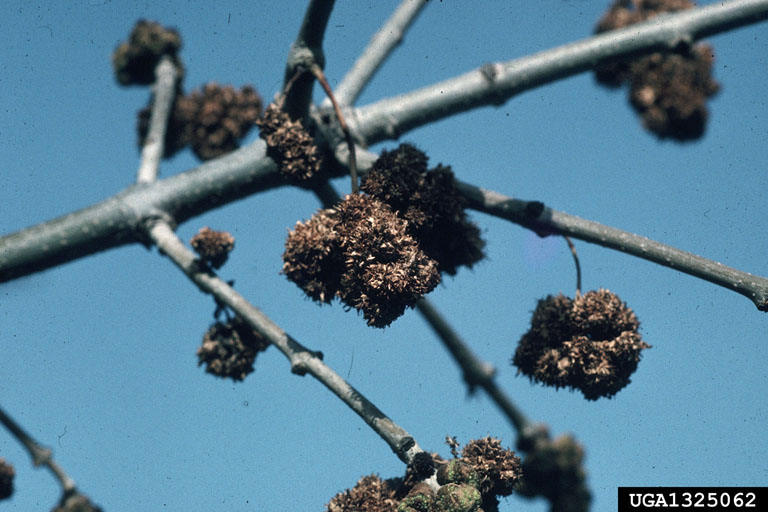 |
| Ash Flower Mite Galls (Whitney Crenshaw, Colorado State University, Bugwood.org) |
Maybe a another word would help. How about ash burls? That got me about a thousand hits, all of them woodworker sites. I tried adding the qualifier, little, and instantly found out that woodworkers use all sizes of burls. Searching with tree crown added didn't help either.
It was starting to occur to me that I had the wrong tree. Maybe it wasn't an ash. Didn't I take a picture of its bark? I downloaded my photos and took a closer look at the bark than I had in the bush. Aha! Not criss-crossy enough to be ash. That's when I remembered that earlier on our walk Ulli had pointed out a hickory nut hollowed out by a red squirrel. It was noteworthy because we don't see them very often up here in central Ontario.
 |
| Bitternut Hickory (Wikipedia) |
Generally, I'm pretty good with my trees but, up until then, hickory hadn't really been on my tree radar. I see their nuts on occasion, but I've never been able to pinpoint the trees they came from. I think the squirrels covet hickory nuts and are willing to travel a distance to gather them, then carry them all the way home to savour later. Like me driving to the city to buy something obscure, but delicious, like tinned cod liver packed in its own oil.
I got out my tree book (yes, I still use books) and quickly confirmed that the tree was indeed a hickory, specifically a Bitternut Hickory (Carya cordiformis). Mystery #1 solved.
Now that this character was named, it was a simple matter to Google hickory gall and – bingo! – I immediately discovered that the growths are called "Hickory Crown Galls."
|
| Bitternut Hickory infested with Phomopsis sp. |
So was the pink stuff an asexual form of a Phomopsis?
Not a chance, since it turns out that Phomopsis species are, themselves, asexual entities, or anamorphs. Their teleomorphs (sexual forms), are all members of the genus Diaporthe, which themselves are devilishly difficult for an amateur to identify. So, at this point, since more than one species of Phomopsis can be found on hickories, I have to be satisfied with a generic solution to Mystery #2: the knobbly, gnarly woody growths are caused by Phomopsis sp.. Though some sites state that Phomopsis is harmless to the tree, it has also been associated with decline in the crowns of infected trees (see here).
 |
| Hickory Crown Gall caused by Phomopsis sp. |
I was still stuck with my primary mystery: What the heck was the pink stuff?
The microscope is rarely my first stop on a search, but it was time to stop dilly-dallying on the internet and look at the pink things more closely. I prepared a slide and took it upstairs.
Well – close up it was just FABULOUS!! The pink matter under the slide cover had separated out into little bundles of cartoon characters!! There was nothing else. There were no basidia, no asci, no sexual reproductive parts of any kind. Just friendly little bunches of cartoon characters. Cartoon-character asexual spores, or conidia. Which made it an anamorph. Which also left me back at square one.
 |
| Aren't they jolly? |

 |
| Each of the bundles (sporodochia - top) is made up of a chain (helicospore) of asexual spores (conidia). |
So how about about the lichens? Do lichens, produce anamorphs? I know a little bit about lichens, but I had no idea if the fungal part of a lichen ever produced anamorphs. A search of pink lichen anamorph got me lots of pictures, including many images of two different lichens – Cryptothecia rubrocinta and Dibaeis baeomyces. Both are lovely, and feature the colour pink, but they weren't what I was looking for.
 |
| Cryptothecia rubrocincta, or Christmas Wreath Lichen (Wikipedia) |
 |
| Dibaeis baeomyces, or Pink Earth Lichen (Wikipedia) |
Are lichens attacked by fungal parasites? I tried pink lichen parasite.
And – ta da! – it took maybe a nanosecond for Google images to start displaying bubble-gum pink characters nestled amidst lichens. But wait! It wasn't an instant slam dunk, because it turns out there are two completely different pink fungi that are both lichen parasites, or lichenicolous: llosporiopsis christiansenii (syn. Hobsonia christiansenii) and Marchandiomyces corallinus (Illosporium corallinum). Macroscopically, the two fungi are teasingly alike. But, though both are anamorphs, I. christiansenii is the asexual form of an unknown ascomycete that produces conidia, while M. corallinus is the asexual form of an unknown basidiomycete that, importantly, does not produce conidia. Finally, Mystery #3 solved!
I. christiansenii's favourite hosts are a number of common, tree-loving members of the genus Physcia (M. corallinus likes these, too!), and sometimes the egg-yolk coloured Xanthoria parietina. Since I wanted to know who the host of my Illosporiopsis was, I spent some time with two of the lichens growing on the gall. The egg-yolk yellow one, Xanthomendoza sp., is not known to be attacked by I. christiansenii. The other, P. millegrana, is. Mystery #4 solved!

 |
| Physcia millegrana with spore-producing apothocia (top) that produced the ascospores & asci (bottom). The green cells are the cholorophyll producing algae. |

 |
| Though I thought at first the yellow/orange lichen on the gall was Xanthoria parietina, it's actually Xanthomendoza sp.. |
You're probably shaking your head at my convoluted, maybe even ass-backwards, method of going about finding the name of this shocking-pink character. My only real excuse is that, of the five tiny patches of this fungus, four appeared to have no affiliation with any of the lichens growing on the gall. And even if they had been clearly growing on the lichen, I did not yet know – though should have guessed – that there are MANY fungal parasites of lichens (more than 1,800 species described!).
But, if I'd been clever enough to have started my search with either pink lichen parasite or pink lichen anamorph, I wouldn't have this complex fungal story to tell.
 |
| It turns out that I. christiansenii isn't particularly rare. In the last few weeks both Ulli and I have found new specimens. When it's wet, like this one, it looks really similar to images of Marchandiomyces corallinus. |
References
Juzwik, Jennifer & Haugen, Linda & Park, Ji-Hyun & Moore, Melanie. (2008). Fungi associated with stem cankers and coincidental scolytid beetles on declining hickory in the upper midwest.
R. Lowen, B.L. Brady, D.L. Hawksworth & R.R.M. Paterson, Two New Lichenicolous Species of Hobsonia, Mycologia 78(5): 842 (1986)
D. Lawrey, James & Diederich, Paul. (2003). Lichenicolous Fungi: Interactions, Evolution, and Biodiversity. Bryologist. 106. 80-120. 10.1639/0007-2745(2003)106[0080:LFIEAB]2.0.CO;2.
Lichenicolous fungi at lichenicolous.net
Marchandiomyces corallinus
Cryptothecia rubrocincta, the Christmas Lichen on Tom Volk's excellent fungi site